

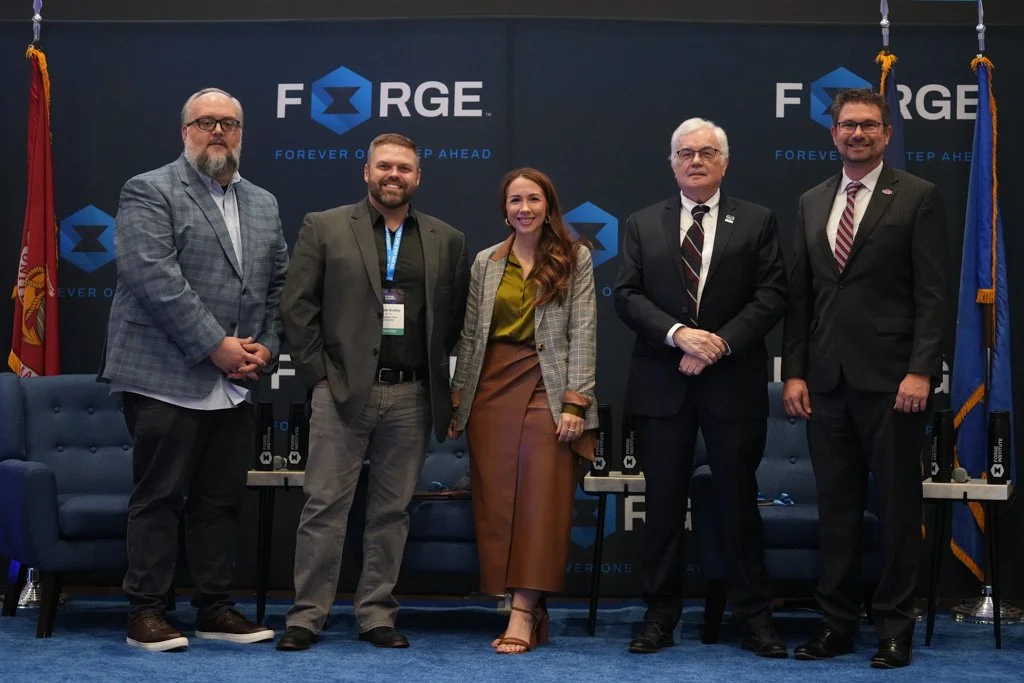
(Left to Right): Lee Watson, Chairman & CEO, Forge Institute; Michael Bradley, Dean of Research and Graduate Studies, Arkansas Tech University; Jaime Land, Director of Government Relations, Arkansas Tech University; Stephen Addison, Dean of the College of Science and Engineering, University of Central Arkansas; Travis Marsico, Vice Provost for Research, Innovation, and Discovery, Arkansas State University.
Arkansas State University, Arkansas Tech University and the University of Central Arkansas sign a memorandum of understanding with Forge Institute at the 2026 Forge Summit, giving federal national-security partners one front door to research talent in the heartland.
Adversaries are investing in science and technology faster than federal grant cycles and acquisition timelines can keep up. The U.S. Intelligence Community has said publicly that it needs a larger pool of talent and wants to lower the barriers for nontraditional providers, including universities, small businesses, and startups. America’s heartland has the people. What it has lacked is the access.
Forge Institute announced the National Security Heartland Innovation Consortium (NSHIC), a research and development partnership among Arkansas State University, Arkansas Tech University, the University of Central Arkansas and the Forge Institute. NSHIC was formed to pursue national-security and defense work - leveraging existing capabilities to support national security mission needs. Leaders of the three universities joined Forge Institute on the main stage of the 2026 Forge Summit to sign a memorandum of understanding committing the members to build it. The MOU is a statement of intent. The work starts now.
Forge Institute is a non-profit “do-tank” that trains cyber defenders, accelerates new defense technology, and helps protect America’s critical infrastructure. We unite the military, government, and private businesses to build capabilities to out-pace foreign threats.
“The heartland has talent the national-security enterprise, specifically the Intelligence Community has not tapped, and three Arkansas universities just put it on the table. Forge’s job is to carry the security, compliance, classified capabilities, and contracting weight so a faculty member in Jonesboro, Conway or Russellville can work on a hard federal problem without building that infrastructure alone. This is exactly why Forge exists, and we are honored to work with leaders who are putting the needs of our national security first.” — Lee Watson, Chairman & CEO, Forge Institute
NSHIC is built to answer what the national-security community has asked for: more nontraditional performers and lower barriers to entry, faster paths from prototype to mission use, and research security built in rather than bolted on. The consortium delivers:
One front door for federal partners. Forge Institute, as consortium manager, provides a single path for contracting, facility clearance and secure workspaces, personnel clearance sponsorship, enhanced export-control and conflict-of-interest safeguards, and program management.
Cross-university research teams ready to task. Research domains include biosciences, agriculture and food security; disease ecology and biosecurity data science; cybersecurity and cyber-range training; data science, software and signal processing; emergency management and resilience; and the energy and nuclear-plant workforce among others.
A clearable talent pipeline. Faculty and graduate students get a path to security clearances, federal laboratories and hard problems. Students get a path into cleared science, technology, engineering and math (STEM) careers that were once available only through institutions on the coasts.
Room for industry. Small businesses, startups and defense industrial base companies can join the consortium as collaborators and transition dual-use technology with the universities.
WHAT EACH UNIVERSITY BRINGS
Arkansas State University is an R2 research university and home to the Arkansas Biosciences Institute, a medical school campus and the state’s first College of Veterinary Medicine. It brings research in biosciences, agriculture and health that national security increasingly depends on, including biosecurity, food, water, and agricultural security, and disease ecology.
“Biosecurity, food and water security and disease ecology are national-security problems. A-State faculty conduct research in these areas. The consortium gives them a path to cleared work and federal partners, and it provides an additional pathway to grow our research enterprise.” — Travis Marsico, PhD, Vice Provost for Research, Innovation and Discovery, and Executive Director of the Arkansas Biosciences Institute, Arkansas State University
The University of Central Arkansas is home to Arkansas’s first ABET-accredited cybersecurity and data science degrees. It brings cybersecurity, data science, software engineering and computer science talent, and will share its expertise with consortium partners for training and exercises.
“Our graduates are domestic, employable and clearance-eligible. The consortium connects them to national-security careers here in Arkansas.” — Stephen R. Addison, PhD, Professor and Dean, College of Natural Sciences and Mathematics, University of Central Arkansas
Arkansas Tech University trains the emergency managers and critical-infrastructure workforce the state runs on, including a large share of the degreed staff at Arkansas Nuclear One. It brings an emergency management and homeland security program, cybersecurity degrees offered since 2017, and a new $2 million National Science Foundation scholarship program for computer science, cybersecurity and engineering students which will make these degrees more accessible to high potential students with limited financial resources.
“The River Valley’s critical infrastructure strongly relies on Arkansas Tech graduates. The consortium lets us put our people and training programs to work on resilience and infrastructure problems for federal partners, and it shows the Legislature the federal return on the state’s investment in ATU.” — Jaime Land, Director of Government Affairs, Arkansas Tech University
A FORCE MULTIPLIER FOR THE MISSION
NSHIC is one part of Forge Institute’s broader mission to connect national-grade expertise and federal resources to the communities and industries that keep America’s critical infrastructure and economy secure. The consortium builds directly on Forge’s existing work in applied research, defense innovation and cybersecurity workforce development in the region. Forge believes the heartland can be the nation’s next national-security research base, and the goal is to stay forever one step ahead.
Universities, small businesses, startups and industry partners interested in joining the consortium as members or collaborators can contact Forge Institute.
Visit www.forge.institute/NSHIC to learn more about the National Security Heartland Innovation Consortium.
###
Key Facts
The National Security Heartland Innovation Consortium (NSHIC) is a research and development partnership among Arkansas State University, Arkansas Tech University, the University of Central Arkansas and the Forge Institute.
The founding members signed a memorandum of understanding (MOU) on October 14, 2026, at the 2026 Forge Summit in North Little Rock, Arkansas.
Forge Institute serves as consortium manager. It handles security, compliance, contracting, classified infrastructure and capabilities, and project management so university researchers can focus on the science.
The consortium gives faculty and graduate students a path to security clearances and federal laboratories, and gives students a path into cleared national-security careers.
